18 Dec 2025
Previously on Building Elbow Arrows…
In part one we identified the design goals (shortest route, minimal segments, proper arrow orientation and shape avoidance), but our naive and greedy first approach to the algorithm turned out to be inadequate on multiple fronts. Therefore this approach is abandoned in favor of a different algorithm.
Games to the Rescue
The design goals were suspiciously similar to the problem of pathfinding in video games, which is a common, well researched problem. Characters in these games often have to find their way from point A to point B on the game map, without getting blocked by obstacles and use the shortest route. They also need to make it look like a human would take that route, so these characters don’t break the immersion. Thus, we turn out focus to A* search algorithm.
Building the Foundations
To understand A* pathfinding we need to understand the context, some of the other graph search algorithms it is built and improved on, and how can they help solve our challenge. To begin with, let’s talk about where A* comes from. It is part of a family of algorithms for graph search, which all aim to find the shortest path in a graph of nodes connected by edges. While this makes them useful far beyond just games, we’ll just focus on pathfinding in a 2D grid (i.e. the canvas). How do we convert the canvas into a graph you ask? If we split it up into a...
Continue reading...
06 Oct 2025
As you may know, Excalidraw is an online whiteboarding application that stands out from the crowd with its distinctive hand-drawn, sketchy aesthetic. Despite this (or likely for this very reason) it is loved and embraced by professionals in various verticals including IT, data analysis, engineering, sciences and much more. Their work often includes creating diagrams conveying flows of information or processes, where clarity is paramount. One of the tools they use to indicate connection between concepts or states is arrows, but straight arrows on a busy board can get clunky fast. Therefore a new type of diagramming arrow was needed.
The Case for Elbow Arrows
Enter elbow (or orthogonal) arrows. These arrows follow 90-degree angles, creating clean, professional-looking diagrams that are easy to follow and aesthetically pleasing. Excalidraw users with heavy diagramming workflows already emulated this type of arrow by painstakingly adding points to simple arrows and dragging them into this 90-degree configuration. Therefore it was clear that implementing an arrow type, which supports this arrow routing would bring instant value.
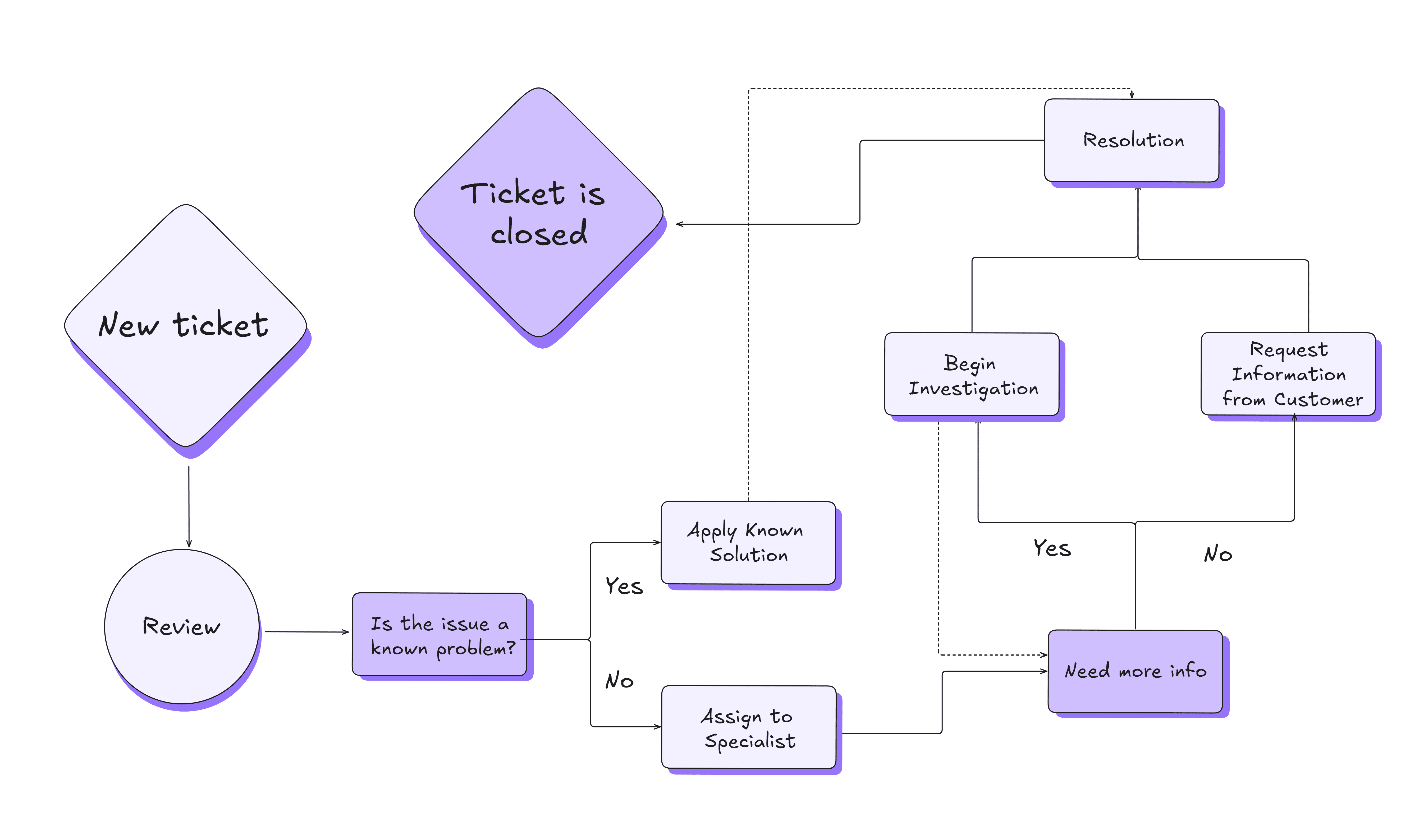
We also quickly realized that it would only be accepted if it “guesses” correctly how a human would route the arrow. This turned out to be the biggest challenge of all. If the arrows look “weird” nobody would use them. So we had to get it right, no matter what “right” means in this context.
Design Goals
We knew from previous experience that we’ll definitely need to add additional...
Continue reading...
14 Jan 2025
Note: If you rather watch a video, a pair-programming session can be found below walking through this article. 
Updated: 2025-01-17 Formatting fixes, fix web-sys features by adding ‘console’
Overview
It’s clear WebAssembly is one of the more popular up-and-coming technologies out there. Its promise, a universal executable format, is not new. In fact it dates back to 1995 (almost thirty years ago!) with Java. Arguably, Java was successful in some areas, many enterprise software is built on Java after all, it tried for a brief time (Java Web Start) and eventually failed to ride the stellar rise of the world wide web. Microsoft .NET is a younger contender, but it arguably suffering from the same adoption challenge as Java. While it can run on most systems now, the web is still not one of them.
Enter WebAssembly (or WASM for short), supported by a wide consortium of players, developed in the open and as an open standard, with the WEB as its primary platform. While it’s too early to tell if WebAssembly will be the winner we’ve been waiting for, its adoption is wide enough, the core technology is stable enough that it’s worth considering it for even professional cases. If in doubt, just consider that Figma, the interface design software, is built on C++ and WebAssembly.
Why is a portable, widely supported executable format is such a big...
Continue reading...